



Advancing Cancer Care Together: The All-Women Research Team Exploring T-Cell Therapy at Osler

July 14, 2026 - Hospital Family Story, Research, Stories
Advancing Cancer Care Together: The All-Women Research Team Exploring T-Cell Therapy at Osler
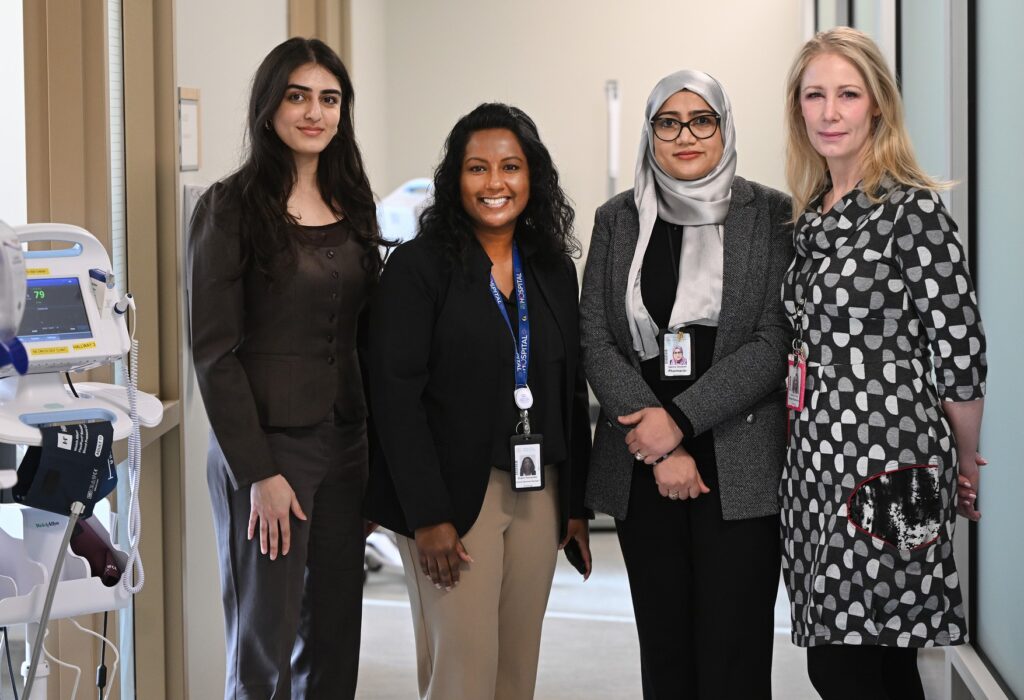
At William Osler Health System, innovation often begins with people—clinicians, researchers, educators, and learners working together to transform emerging treatments into safer, more accessible care. An all-women interdisciplinary team is doing just that through groundbreaking research into T-cell engager therapy, an evolving form of immunotherapy that harnesses the body’s own immune system to fight cancer.
For neuroscience undergraduate and Summer Student Research Program participant Diya Nijjar, the project was both a professional opportunity and a personal one. Having grown up in the Brampton community and experienced the impact of cancer within her own family, contributing to oncology research at Brampton Civic Hospital felt deeply meaningful. But from the start, she saw that innovation in health care is never the work of one person.
“What stood out to me right away was how many different perspectives came together,” says Diya. “Each member of the team brought a unique expertise—from pharmacy to nursing to clinical leadership—and seeing how those pieces connected showed me how much collaboration goes into introducing a new therapy safely.”
T-cell engager therapy represents a significant shift in cancer treatment. T-cells are a type of immune cell that act as the body’s natural defenders, identifying and attacking threats. This therapy works by guiding those cells directly toward cancer, helping the immune system recognize and target what it needs to fight. While promising, activating the immune system in this way can trigger strong reactions that require careful observation, particularly during early dosing.
As T-cell therapies become more widely used, understanding how patients respond in real-world clinical settings is critical. The Osler team set out to examine when immune-related reactions occur, how severe they are, and how care teams can better anticipate and manage them to improve patient outcomes.
Introducing advanced therapies into clinical practice requires careful coordination. Before beginning the research itself, Diya spent time shadowing members of the interdisciplinary team—learning about dosing schedules from pharmacists, patient monitoring from nurse educators, and the clinical workflows that ensure safe delivery of treatment. The experience revealed the extensive preparation required behind the scenes before a new therapy becomes routine care.
Through a retrospective review of patient cases, the team identified a critical window for monitoring: most immune-related reactions occurred within the first 48 hours after treatment began, with many appearing within the first 24 hours. These insights are helping clinicians refine monitoring strategies and inform future protocols, ensuring patients receive both innovative treatment and safe, responsive care.
“Being able to learn from each member of the team and see how their expertise shaped the project was incredibly inspiring.”
Beyond immediate clinical learning, the research contributes to a broader goal—exploring how portions of T-cell therapy could safely transition from an inpatient model to outpatient care. Such a shift could significantly improve the patient experience by reducing time spent in hospital while also expanding access to advanced treatments and supporting more efficient use of hospital resources.
For Diya, the experience reinforced the importance of collaboration in advancing health care innovation. “I didn’t realize how many people and processes were involved behind the scenes,” she says.
Ultimately, the work demonstrates that innovation in health care is rarely the result of a single breakthrough. Instead, it emerges from teams willing to examine existing practices, learn from patient experiences, and continuously refine care. Through collaboration, clinical expertise, and a shared commitment to improving outcomes, this all-women research team is helping shape how advanced immunotherapies are delivered—bringing the future of cancer care closer to patients today.
This progress doesn't happen by chance. It happens because donors invest in innovation that brings new possibilities to patients and families facing cancer.
Your support today can help accelerate discoveries that improve outcomes and bring the future of cancer care closer to home.
Make your gift today and help fuel the next breakthrough.
Stay in Touch!
Your donation has a lasting impact. Subscribe to our newsletter to learn about how your gift is making a difference.